Amit Arora on AI for Online Course Creation
 David Zenler
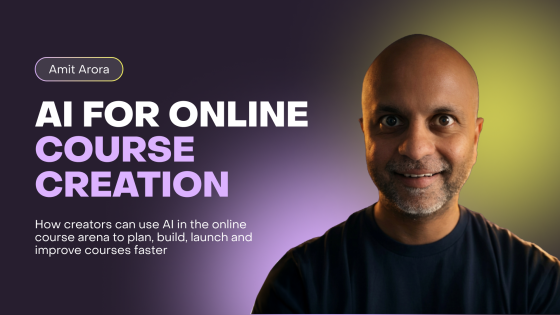
Amit Arora shows how creators can use AI in the online course arena to plan, build, launch and improve courses faster.
Creating an online course sounds simple from the outside.
You know something valuable.
You teach it.
People buy it.
Done.
Except anyone who has actually created a course knows there is a lot more going on.
You need the right idea, the right structure, the right lessons, the right offer, the right student journey, the right platform setup, the right marketing and the right support after people join.
That is a lot.
And this is exactly where AI can become useful.
Amit Arora’s session, How AI Can Be Used in the Online Course Arena, is a practical spotlight inside the Future of AI for Course Creators Summit 2026, focused on how AI can help creators build, organise and move faster in the real world of online course creation.
Not theory.
Not hype.
Practical use.
The kind that helps creators get from idea to implementation without getting lost in the middle.
Quick answer: Amit Arora on AI for Online Course Creation explains how to amit Arora explains how creators can use AI in the online course arena to plan, build, launch and improve courses faster.
Why AI Matters in the Online Course Arena
Online course creation has changed.
A few years ago, most creators were focused on recording lessons and uploading videos. That was the main job.
Now, course creators need to think about a much wider business system.
They need content, marketing, sales pages, emails, student onboarding, communities, live sessions, support, automation and course improvement.
That is why AI matters.
AI can help creators deal with the complexity.
It can support planning, drafting, organising, editing, improving and launching.
Think again if you believe AI for online courses is just about writing lesson titles.
That may be useful, but it is only a tiny part of the opportunity.
AI can help you turn rough expertise into a clearer course pathway.
It can help you see what students need first.
It can help you create supporting resources.
It can help you build faster without skipping the thinking that makes a course valuable.
AI Can Help Turn Expertise Into a Course Structure
Many creators know their subject deeply.
Sometimes too deeply.
That creates a strange problem.
When you know a topic well, it can be hard to remember what beginners need first. You may want to include everything. You may skip basic steps because they feel obvious to you. You may organise the course around your knowledge instead of the student’s journey.
AI can help here.
It can act like a course planning partner.
You can give AI your topic, audience, outcome and teaching style. Then ask it to help organise the learning path.
For example, instead of saying:
“Create a course about photography.”
You could say:
“Help me structure a beginner photography course for small business owners who want to take better product photos using a smartphone. The outcome is that they can create clean, confident product images for their website and social media without hiring a photographer.”
That gives AI useful context.
Now the course can be built around a specific learner, a specific problem and a specific result.
Much better.
This is simple to do, but it makes a huge difference.
Because a good online course is not just a collection of lessons.
It is a path.
AI for Lesson Planning and Course Outlines
One of the most useful ways to use AI is to create a first version of your course outline.
Not the final version.
The first version.
That distinction matters.
AI can help you identify modules, lesson topics, key teaching points, examples, exercises and possible student milestones.
You can then review the outline and improve it with your own experience.
For example, AI might suggest a module that is too advanced too early. You can move it.
It might miss a mistake your students often make. You can add it.
It might create a lesson title that sounds too generic. You can rewrite it.
The point is not to let AI design the course alone.
The point is to avoid starting from a blank page.
Course creation becomes much easier when you have something to shape.
This connects naturally with David Newton’s session on AI workflow for creators, because AI works best when it supports your thinking and helps you move from scattered ideas into action.
AI Can Help Build Course Materials Faster
Once the course structure is clear, creators still need supporting materials.
This is where AI can save a lot of time.
It can help draft worksheets, lesson summaries, action steps, quizzes, reflection questions, checklists, email reminders and onboarding messages.
For example, if you have a lesson on “choosing your course topic”, AI can help create:
a worksheet for brainstorming topic ideas
a checklist for validating demand
reflection questions for narrowing the niche
a summary of the key points
an email reminder encouraging students to complete the task
That is useful.
But again, the creator should review everything.
Your examples, stories and teaching method still matter.
AI can create structure.
You add the experience.
That combination is powerful.
AI for Building and Deploying Faster
Amit’s session is especially useful because it points towards a practical creator need: speed.
Creators often get stuck between idea and launch.
They spend weeks thinking about the course.
Then weeks planning the website.
Then weeks writing the page.
Then weeks sorting emails.
Then more weeks worrying about whether it is good enough.
By the time they are ready, the momentum has faded.
AI can help creators build and deploy faster by reducing the time spent on first drafts and setup thinking.
It can help outline website pages, create landing page sections, draft course descriptions, write FAQs, suggest onboarding flows and map the student journey.
This does not mean rushing poor work into the world.
It means removing unnecessary friction.
A creator with a solid idea should not be stuck for months because they cannot write the first version of a sales page or organise their lesson descriptions.
AI can help you move.
Then you refine.
That matters for online course creators because speed creates feedback.
And feedback is what helps you improve.
AI and the Future of Online Course Platforms
AI becomes even more useful when it is connected to the platform where your course lives.
If AI can help with content planning, student support, marketing and delivery, then the course platform itself becomes a much bigger part of the creator workflow.
This is why Rakesh’s session on AI course platforms is closely connected to Amit’s topic.
Amit’s session looks at how AI can be used in the online course arena.
Rakesh’s session looks at how AI and agentics are changing the platforms creators use.
Together, they show where things are heading.
Creators do not just need a place to upload videos.
They need smarter systems that help them build, sell, support and improve their courses.
AI can play a role across all of that.
AI Can Improve the Student Experience
A good online course is not judged by how much content it contains.
It is judged by whether students make progress.
That is important.
Creators often think they need more lessons, more bonuses, more resources and more material.
Sometimes they do.
But often, students need more clarity.
They need better guidance.
They need reminders.
They need simpler explanations.
They need help finding the right next step.
AI can support this.
It can help create onboarding messages that guide students through the course.
It can generate lesson summaries that make content easier to review.
It can turn common questions into FAQs.
It can help students find the right resource faster.
It can support implementation by turning lessons into action steps.
This connects well with Gemma Went’s article on AI inside memberships, because both courses and memberships benefit when AI helps learners take action, not just consume more content.
Remember, more content does not always mean more value.
Better support often does.
AI for Course Marketing and Sales Pages
Building the course is only one part of the job.
You also need to sell it.
This is where many creators struggle.
They understand their topic, but find it hard to explain why someone should buy now.
AI can help with marketing by turning course features into benefits, identifying audience objections, creating sales page outlines, drafting email sequences and testing different offer angles.
For example, instead of saying:
“This course includes 8 modules, 25 lessons and downloadable templates.”
AI can help you turn that into a stronger benefit-led message:
“Build your course step by step without guessing what to teach, how to structure it or how to guide students towards a result.”
That is more meaningful.
People do not buy modules.
They buy outcomes.
This is where Mike Samuels’ session on AI sales copy without losing the human voice becomes especially relevant. AI can help you write faster, but your sales copy still needs trust, clarity and a human feel.
AI for SEO and Course Discovery
Once your course exists, people need to find it.
AI can help creators plan SEO-friendly content around their course topic.
This might include blog posts, FAQs, comparison articles, how-to guides, glossary-style explanations and pillar content.
For example, if your course teaches public speaking, AI can help identify content topics around speaking anxiety, presentation structure, storytelling, confidence, workplace communication and webinar delivery.
Each article can attract people at different stages of awareness.
Some are just discovering the problem.
Some are looking for help.
Some are ready to buy.
This is where Neil Patel’s session on AI SEO for course creators fits naturally into the bigger summit conversation.
AI can help with keyword ideas and structure, but the best SEO content still needs real teaching, examples and helpful answers.
AI can support discovery.
Your expertise creates trust.
AI Can Help Creators Avoid Overbuilding
One of the biggest mistakes course creators make is overbuilding.
They spend months creating a huge course before testing whether people want it.
They add too many lessons.
They create complicated modules.
They build a full library before getting real feedback.
AI can help, but it can also make this worse if you are not careful.
Because AI makes it easy to generate more.
More lessons.
More worksheets.
More bonuses.
More ideas.
That sounds helpful, but it can lead to overload.
The smarter use of AI is to help you build the simplest useful version first.
What does the student need to get the first meaningful result?
What lessons are essential?
What can wait?
What should be tested before it becomes a full module?
AI can help you simplify your course if you ask it the right questions.
For example:
“Review this course outline and suggest what can be removed, combined or moved to a bonus section so the learner gets the fastest clear result.”
That is a better use of AI than simply asking it to add more.
Practical Ways to Use AI in Online Course Creation
If you are a course creator, you do not need to use AI everywhere at once.
Start with one stage of the course process.
You could use AI to validate your idea, structure your modules, draft lesson summaries, create worksheets, write onboarding emails, plan your launch content or improve your sales page.
A simple workflow could look like this:
define the audience
define the course outcome
ask AI to suggest a learning path
review and improve the outline
create lesson summaries
build simple action steps
draft onboarding emails
create course FAQs
plan launch content
review everything in your own voice
This keeps AI useful without letting it take over.
The creator still leads.
AI supports.
That is the balance.
AI Should Help You Teach Better
The best use of AI in online courses is not just faster creation.
It is better teaching.
Can AI help you explain something more simply?
Can it help you create a clearer worksheet?
Can it help you identify where students may get stuck?
Can it help you turn a long lesson into practical steps?
Can it help you create better support between lessons?
That is where AI becomes genuinely valuable.
Because course success is not about how fast you can produce content.
It is about whether students can understand, implement and get results.
Keep your eyes open here.
The course creators who benefit most from AI will not be the ones who create the most material.
They will be the ones who use AI to create clearer learning experiences.
FAQs About AI for Online Course Creation
How can AI be used in online course creation?
AI can be used to plan course outlines, structure modules, draft lesson summaries, create worksheets, write quizzes, build onboarding emails, support student questions, improve sales pages and plan launch content.
Can AI create a full online course?
AI can help create a first draft of a course structure and supporting materials, but it should not replace the creator’s expertise. A strong course still needs human judgement, teaching experience, examples and a clear student outcome.
Is AI useful for beginner course creators?
Yes. AI can be very useful for beginner course creators because it helps turn rough ideas into structure. It can support planning, lesson order, content creation, marketing and student onboarding.
Can AI help improve existing courses?
Yes. AI can help review existing course outlines, identify missing lessons, create better summaries, improve worksheets, organise FAQs and suggest where students may need more support.
How can AI help course creators sell their courses?
AI can help with sales page outlines, email sequences, offer messaging, audience objections, benefit-led copy, launch content and FAQs. The creator should still review the copy to make sure it feels accurate and human.
Should course creators use AI for student support?
Yes, AI can support student support by helping create FAQs, lesson summaries, onboarding messages and resource recommendations. It should support human teaching, not replace personal connection where it matters.
Final Thoughts
Amit Arora’s session, How AI Can Be Used in the Online Course Arena, is valuable because it focuses on practical use.
AI can help course creators plan faster, build smarter, create better materials, support students and bring ideas to life with less friction.
But the real opportunity is not just speed.
It is clarity.
AI can help you turn your expertise into a better learning path.
It can help you avoid the blank page.
It can help you launch with more confidence.
It can help you improve the student experience.
Used properly, AI becomes a practical assistant for the full online course journey — from idea to launch to student success.
Join the Future of AI for Course Creators Summit 2026 to learn how Amit Arora and other expert speakers are helping creators use AI in useful, human and business-focused ways.
Want to build, sell and grow your online courses, memberships and communities from one place?
Try Zenler Risk Free for 30 Days and unlock the Accelerator Program that guides you step by step toward success.
https://www.newzenler.com/register
Related AI workflow resources
Use these Zenler guides to connect AI ideas with practical course business workflows:
- How course creators can use AI agents without losing their brand voice
- AI course launch checklist for New Zenler creators
- AI agents for course creators: practical workflows and examples
Categories: : AI for Course Creators
Copyright © 2026 Zenler. All rights reserved.
Terms | Privacy Policy | Cookie Policy | Support